If you follow this blog you know I’ve been considering math recently. “Why?” you might be thinking. It’s simple, I want to better understand the world. I feel like the more you know about something the more interesting it becomes. So, I’m considering mathematics in our world.
Take the number 5 for instance. It’s a good sturdy number. It takes up one handful of fingers nicely.

So, lets see what we can do with 5. Lets take 5 lines of equal length, flip, flip flip, we have a pentagon.
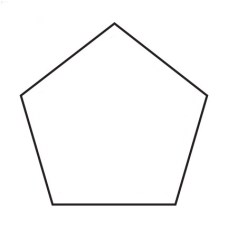
Now lets take 5 more straight lines of equal length, flip, flip flip, from here to there, there to here.
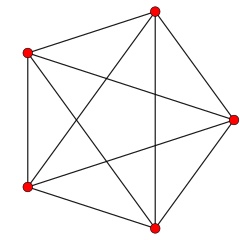
Bingo, a star inside a pentagon. Not only that, we have also cleverly created another pentagon. Indeed, if you are so inclined you could do that forever.
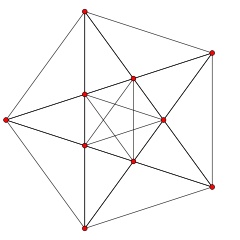
If you aren’t interested in forever smaller stars and pentagons, we can move on to investigate another number.
1 + √5
2
“Hold it right there,” you might be saying, “I didn’t sign up for this.” I know, it looks like math, but you don’t have to do anything with the equation except look at it. It’s a lovely thing. In fact, mathematicians think this is such a beautiful number they gave it a name.
Let me introduce you to Phi which uses the symbol:  also written:
While I agree that Phi looks like a random sort of number, let me assure you it is special. In fact, I’m sure you’ve seen evidence of Phi in your own life. But, let’s set that aside for the moment and take a trip to ancient Greece. Around 300 BCE a mathematician named Euclid defined what is now known as the Golden Ratio. To define it, he said to consider a line divided in a specific way (this is how mathematicians spend their time, they contemplate lines).
Here is Euclid’s line. It is divided into two sections, AB and BC.
A_______________________________________B_____________________ C
Altogether, this line has three different segments: AC, the whole line, AB the larger of the two sections and BC the smaller section. The Golden Ratio is a line where the ratio of AC to AB is the same as the ratio of AB to BC. In other words, the ratio of the full line to the larger section of the line is the same as the ratio of the larger section to the smaller section.
Sounds irrelevant, right? However, if you pull out your trusty ruler and pocket calculator you will find the same ratio in the star inside the pentagon.
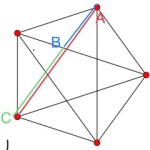
Look at that, you have discovered your very own Golden Ratio. There is Euclid’s line inside the pentagon.
“Amazing,” you are probably saying. “I’m going to immediately text all my friends.” But, wait, it gets even better.
Let’s bring Phi back into the equation. It turns out that if you figure out what that ratio, the Golden Ratio, the ratio of length AC to AB etc, you will find it is
1 + √5
2
Ah ha!
Phi is the Golden Ratio. The Golden Ratio is Phi. No wonder it gets its own name.
If you were to work out the above equation you see that Phi is equal to 1.618… Those three dots means the number goes on and on and …. Phi is one of those numbers, like Pi, that goes on forever without repeating. (In another post I’ll show how they know that).
Phi makes beautiful star pentagons. There are also Golden Spirals and Golden Rectangles, all made with this same ration.
For example: this is a Golden Rectangle. You can use it to make all sorts of things. Like the star pentagon you can use the Golden Ratio to create ever smaller Golden Rectangles.
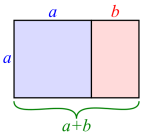
from here you can create a Golden Spiral. Notice the successively smaller rectangles used to create the spiral.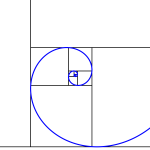
You could make the same spiral with Golden Triangles. 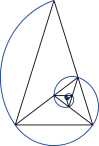
Phi is not just found in geometry. It is found everywhere from art to pineapples. If you are ever looking for something to do try counting the seeds in a sunflower. If you look closely you will see the seeds make 2 spirals in opposite directions. If you count the seeds of one spiral and divide by the number of seeds in the other spiral you should get the Golden Ratio (if not you may need to count again).
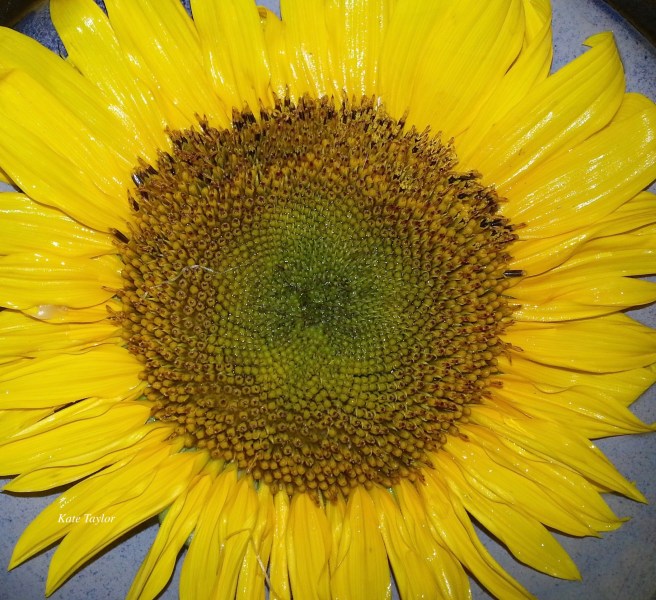
If you don’t feel like doing the math to find Phi we can take a detour to Italy to meet Leonardo of Pisa, aka Fibonacci (c 1175-1250). Fibonacci rediscovered a sequence of numbers that was first described by Indian mathematicians hundreds of years earlier. Fibonacci numbers are a sequence of numbers created by adding the previous two numbers together. For example if you start with 1,1, you add them together to get your next number: 2. Add that to the previous (2+1) to get 3. Add 3 to the previous (+2) is 5.
Then:
5 + 3= 8
8 + 5 =13
13 + 8 = 21
21 + 13 = 34 ….
What makes this sequence interesting is that as the numbers get larger the ratio between two consecutive numbers gets closer and closer to … you guessed it … Phi.
the ratio of 1 : 1 = 1
The ratio of 1 : 2 = 2
2 : 3 = 1.5
3 : 5 = 1.66666666666667
5 : 8 = 1.6
8 : 13 = 1.625
….
46368 : 75025 = 1.6180339889579 That’s starting to get pretty close to Phi!
So now you see what pentagons and sunflowers have in common. They both contain Phi.
It is often said that Phi is an aesthetically pleasing ratio and it certainly can be found in art. (Go to https://www.pinterest.co.uk/pin/312366924129044770/ if you want to see examples.) Phi is also found in pineapples, and pine cones. Some people claim the proportion of fingers to knuckles is Golden. It does seem to be everywhere. If you look around you might see signs in front of stores, or sea shells, or your favorite artwork with proportions that look “Phi-ish.” So, if you want to know your world better, take a look around.

If you found this interesting you might like:
What you should know about money.
How Do You Know? A Look at Knowledge
Is Math Broken? The Problem of Infinity.
World Scientists’ Warning to Humanity: A Second Notice
The Law Against Clean Houses
If you found this less interesting than some posts you might like:
Cat Show
Sunny Ice
Beautiful Storm
Killer Cats
Discover more from The Nature of Things
Subscribe to get the latest posts sent to your email.


I found that fascinating… :)….really! and it looks like I missed a couple of blogs, I’ll have to go an look.
On Sat, Feb 3, 2018 at 4:35 PM, The Nature of Things wrote:
> notes with coffee posted: “If you follow this blog you know I’ve been > considering math recently. “Why?” you might be thinking. It’s simple, I > want to better understand the world. I feel like the more you know about > something the more interesting it becomes. So, I’m considering math” >
LikeLike