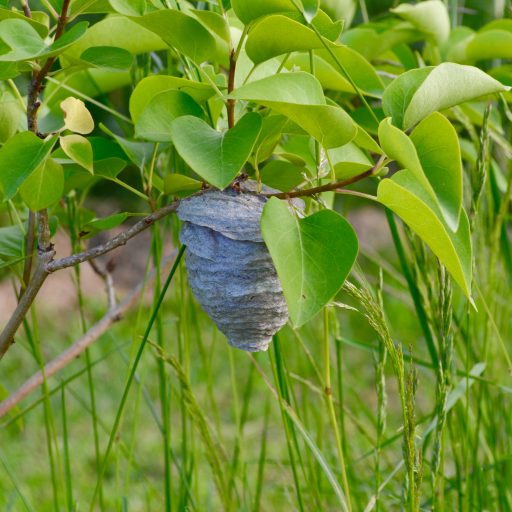
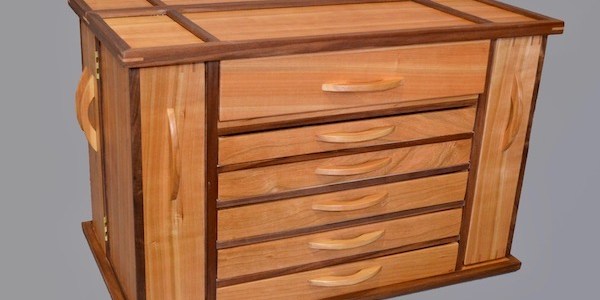
Shellac has a long history. It was known as far back as the Vedic period in India around 3,000 years ago when it was used as a medicine as well as a dye. In later years it became a popular finish known for its durability and ease of use. In the West it was used as a finish as early as the mid 17th Century.


photos and boxes by Kate Taylor Creative Woodworking
 as well as on candy, processed food and pharmaceuticals. (If you are using shellac as a finish don’t drink it. It is dissolved in denatured alcohol. Once dried it is again non-toxic.)
All this usefulness comes from a tiny bug. Shellac is made from the resinous secretion of microscopic bugs collectively known as lac bugs. (For those entomologists among us, lac bugs are from the coccoidea family and include Laccifer lacca, Carteria lacca and Tachardia lacca.) The process of making shellac starts with these microscopic creatures.
It begins when huge numbers of lac bugs colonize branches of host trees. Lac bugs are most common in India and Thailand where many different types of trees host the bug. Those trees include members of the soapberry, pea, buckthorn and mulberry families. It takes about 100,000 lac bugs to make 500 g of shellac flakes. In fact, the word “lac” comes from the Sanskrit word “lakh” which means 100,000.
The lac bugs feed on the tree, sucking sap into their proboscis and then secreting the resinous lac. The males fertilize the females and then fly away, while the females never develop wings. Instead they lay around 1000 eggs each and continue eating and secreting lac until they die. During this process the lac builds up on the branches, ultimately covering both the female bugs and the eggs.
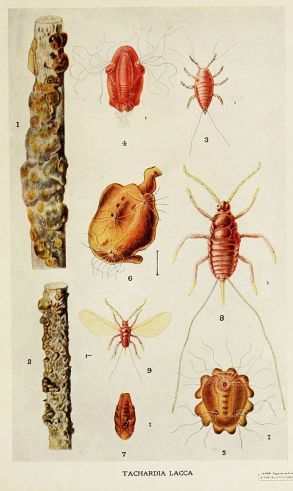
The secreted lac hardens, protecting the eggs from predators. Unfortunately for the lac bug, it attracts humans. Once the branches are thick with resin the branches are harvested as sticklac.
Sticklac refers to the entire branch that is coated with the resin of the lac bug. Workers cut the resin coated branches then crush and sift the sticklac to remove dirt and bug parts. It is then washed to further remove impurities. From this point the lac is called seedlac.
Seedlac comes in a variety of colors depending on the type of host tree as well as the species of lac bug. The color of the lac can be dissolved away in water. It is removed and used as dye or left in the seedlac to give color to the final product. After repeated washings the seedlac is laid out to dry. To turn the seedlac into shellac it is treated with either heat or solvent.
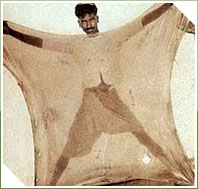
Traditionally the lac is heated in cloth tubes which can be as long as 40’. The tubes are held over a fire in sections to heat the seedlac. As it melts a worker twists the cloth tube which acts as a sieve, further cleaning and purifying the lac as it passes through the fabric. If the worker wants to make button lac then the hot lac is scraped from the cloth and dropped onto a hard surface where it forms into little puddles of button lac. These can be stamped with a makers mark and left to harden.
If shellac flakes are preferred the shellac is stretched into thin sheets while still warm. Then the sheet is cooled until brittle. When made by hand a worker molds the sheet and then stands in front of a fire while the shellac dries. The dried sheet is then broken into small pieces.
The same process can also be done using steam and hydraulic presses. The heating process keeps the wax in the shellac. To make de-waxed shellac such as that used by woodworkers, the lac is dissolved in a solution (usually industrial alcohol) and then filtered. The alcohol is evaporated and recovered and the shellac is pressed into sheets and then broken into flakes. This process allows the manufacturer to control the amount of wax in the shellac. The wax itself can then be reclaimed from the process and used for polishing.
Shellac and de-waxed shellac can both be used as a finish. If the shellac is being used as a sealer, it’s best to use the de-waxed shellac as some finishes don’t adhere well to the wax. If the shellac is going to be the final finish either will do. In either case it makes for a beautiful finish.
Thanks for reading,
Kate
June 27, 2018
If you enjoyed this post check out my woodworking website at
www.wooden-box-maker.com
or you might like my photography at
www.Vermontphotos.net
Discover more from The Nature of Things
Subscribe to get the latest posts sent to your email.


Huh. I learned a lot.
Getting ready for the new teacher?? Or is this an assignment??
On Tue, Jun 26, 2018 at 11:44 AM, The Nature of Things wrote:
> notes with coffee posted: “Shellac has a long history. It was known as far > back as the Vedic period in India around 3,000 years ago when it was used > as a medicine as well as a dye. In later years it became a popular finish > known for its durability and ease of use. In the West it wa” >
LikeLike