

I’m getting ready for a road trip, so I’ve been thinking about distances.
To drive across the USA takes around 45 hours. It’s a little over 3,000 miles to cross the country. That distance is greater than the diameter of the Moon. Our little companion is only 2100 miles in diameter.
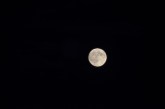
Earth has a diameter of nearly 7,900 miles.

The Sun, on the other hand is 865,000 miles in diameter. You could line up 109 earths across the sun. No, you couldn’t they would burn up, but in theory….
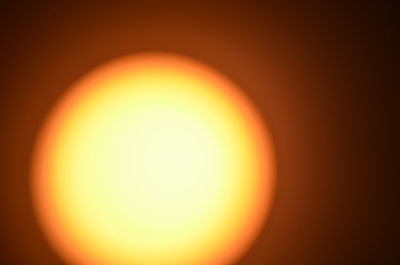
So to recap our diameters:
Moon 2,100 miles
Earth 7,900 miles
Sun 865,000 miles
Think about how long it takes to fly around the earth, now imagine flying around the sun. It would literally take months to get around it.

But, those are the small numbers. Now lets talk about distance. (Distances are all averages because planets have elliptical orbits.)
The Moon is 238,900 miles from Earth. (When astronomers talk about a “near-earth” asteroid they mean anything within a million miles of Earth.)
The Sun is 93,000,000 miles away. That’s 93 million miles (makes the Earth’s 7,900 diameter seem pretty tiny). Astronomers call this distance 1 astronomical unit (technically 149,597,870,700 meters).
 This block represents 1 AU, 93 million miles.
You realize space is pretty big when you look at how far we are from the other planets.
Mercury 57,974,000 miles .61 AU

Venus 25,725,000 miles .28 AU Our closest neighbor at a mere 26 million miles away.

Mars 48,678,000 miles .52 AU

Jupiter 390,674,000 miles 4.2 AU
Saturn 792,248,000 miles 8.52 AU
Uranus 1,692,663,000 miles 18.21 AU Note that we are up to billions of miles now.

Neptune 2,703,960,000 miles 29.9 AU

I’m going to include Pluto because it once was a planet.
Pluto 4,670,000,000 miles 40AU
Remember the distance to Venus:
We are far away from Pluto and it blows my mind that humanity was able to send a craft out that far. But, that’s a skip in the pond compared with Voyager 1 which is 139 AU or 10,137,000,000 miles (I’m not going to block it out) from Earth and still moving.
Our nearest neighbors, Alpha Centauri A and B, are around 4.22 light years away. That’s over 276,000 AU or 5,878,625,000,000 miles (that 5 is in the trillion spot, my friends).
Space is big.
For a great sense of scale check out this webpage: http://joshworth.com/dev/pixelspace/pixelspace_solarsystem.html and don’t forget to check out the light speed button in the lower right.
It makes my road trip feel like standing still!
Happy trails.

Discover more from The Nature of Things
Subscribe to get the latest posts sent to your email.


This makes me wonder how we can get a solar eclipse, the sun is so far away it is tiny in the distance and the moon can cover it up? How do you like my scientific terminology??
LikeLike
Amazing thing indeed. The distance are astronomical (sorry).
LikeLike
If the sun is so big and the moon so small, how can the moon cover the sun? It is because the moon is so close to the earth.
Next time you see a jet in the sky hold your thumb at arm’s length and close one eye. The jet is the sun, your thumb is the moon. For that matter, do the same with a full moon sometime. It’s surprising how small the moon actually is in the sky.
LikeLike