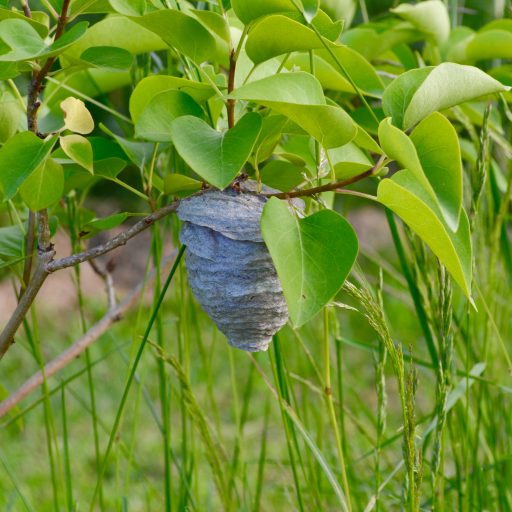
I was out butterflying the other day, looking for hairstreaks. I was hoping to see either a banded or a striped hairstreak, both of which are relatively common in Vermont. That doesn’t mean easy to find. Hairstreaks are small butterflies, often with a drab background color broken up by occasional bright spots or streaks. They nectar from flowers, sometimes hanging upside down, or hidden among the plant’s foliage. Even with an eye out for them it’s easy to miss them.
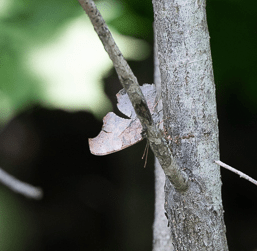
I was walking along a quiet dirt road. I’d just had an interaction with a question mark butterfly (Polygonia interrogationis). It first flew by too quickly to identify, so I stopped to see if it would return. I have learned the hard way that chasing butterflies rarely works, but many species will patrol an area, circling and returning. Sometimes it will even stop and perch for you to admire it.
I was hoping this was the case for my mystery butterfly. Sure enough, within a few moments it returned to hide in the leaves of a beech tree. I was trying to convince myself that the roadside wasn’t that steep and I could clamber closer, when the butterfly obligingly flew close enough for a photo. Yup, that “dead leaf” in the photo is a question mark butterfly.
Here are a few more photos of a different individual. In them you can see the white lines on the underside of the wings which give it its name.
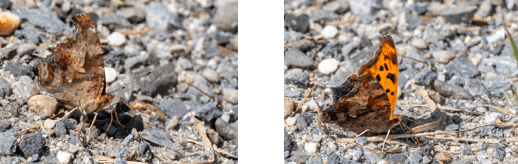
I admired the camouflage and watched bright flashes of orange as it stretched it’s wings, then I continued my walk.
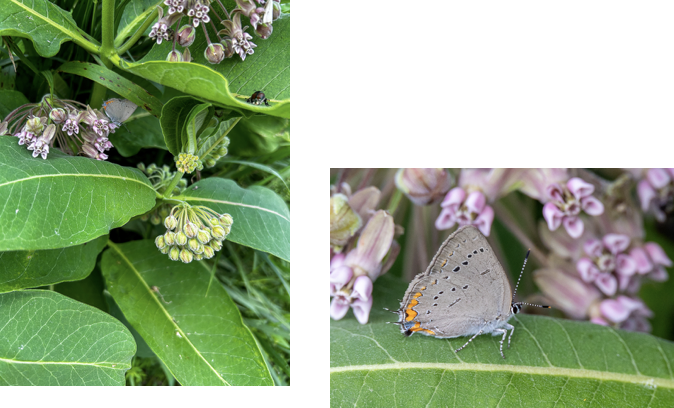
I was checking all the milkweed plants that I came across, since hairstreaks (and other butterflies) love them. I was right by a farm house, peering at a milkweed plant, when I noticed a tiny flash of orange. Wahoo! Not a striped hairstreak, not a banded hairstreak, but an acadian hairstreak. I was thrilled. I admired it for quite awhile, and it wasn’t until I walked on that it occurred to me to wonder what the people in the farm house thought of me with my nose in the milkweed for 20 minutes. Oh, but it was worth it.
The Acadian Hairstreak (Satyrium acadica) is a small butterfly with a gray-brown background broken up, on the underwing, by bright orange spots. They are rare in Vermont, but don’t seem to be endangered and their population is stable. They mostly fly late June through early August. Their host plants are willows (Salicaceae), but adults like milkweed. I later saw one on a thistle.
This was the first one I had seen. If I hadn’t been looking closely I would have missed it. In the photo to the left you can see a beetle on the top leaf. Once you find the hairstreak, in the same photo, you can get a sense of just how small hairstreaks are.
Thanks for looking,
Stay well, be curious, learn things.
Kate
July, 2024
If you enjoyed this post perhaps you will enjoy these as well.
- The Beauty of Winter
- Flying Tutus
- Glaciers to Gardens
- Night Lights in June
- Happiness Practice – Day 7
Discover more from The Nature of Things
Subscribe to get the latest posts sent to your email.

 The Nature of Things