
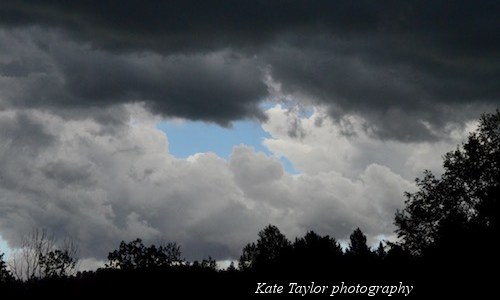
The Earth is protected from the vastness of space by a thin envelope of gas held in place by gravity. Without that layer, without our atmosphere, we could not survive. Not only does the atmosphere contain essential gases (including oxygen,) but it also regulates the sun’s energy as it hits the Earth.
Greenhouse gases are a natural part of the atmosphere. They are gases which trap solar rays, keeping them from reflecting back out to space. They are an insulating blanketing protecting the Earth. Without them the earth would be around −18 °C (0 °F), rather than the present average of 15 °C (59 °F.) 1
The problem comes when we have too much of a good thing. When that insulating blanket builds up too much it traps too much heat. With nowhere else to go that heat begins to warm the atmosphere, the oceans and the earth itself. That is where we find ourselves today.

The primary greenhouse gases in Earth’s atmosphere are water vapor (H2O), carbon dioxide (CO2), methane (CH4), and nitrous oxide (N2O). Ozone (O3) can be a greenhouse gas, but it acts differently depending on where it is in the atmosphere. In the upper atmosphere (the stratosphere) it collects in layers that reflect harmful ultraviolet (UV) rays back into space. At lower altitudes (the troposphere) ozone is a harmful greenhouse gas. Overall, the positives of the protective ozone layer are greater than the dangers of the lower pollutant. The other gases are also necessary to an extent and dangerous in excess.
Since the beginning of the industrial revolution, the developed world has pumped massive amounts of carbon dioxide, methane and other pollutants into the air. These excess greenhouse gases are trapping more heat than in the past causing global temperatures to rise. This global warming is leading to overall climate change as weather patterns shift and the old “normal” fades.
Our atmosphere is made up of nitrogen (around 78%,) oxygen (around 21%) and smaller amounts of argon, carbon dioxide, helium, and neon.
No one really knows what will happen if we continue to trap heat as we are now. Scientists can extrapolate from previous eras of climate change and computer models can predict what might happen if we speed up the normal process exponentially, but this has never happened before. Our great experiment is changing the makeup of the lower layers of the protective blanket surrounding us.

The greenhouse effect has been understood for centuries. It was first experimentally demonstrated by Eunice Foote in 1856. Using glass cylinders and an air pump she noted temperature differences between gases under various pressures. She tested “common air” as well as hydrogen, oxygen and carbon dioxide (then called carbonic acid.) From her results she found that the type of gas as well as its density and humidity effected the temperature. Further, she noted that carbon dioxide became much warmer when placed in sunlight than did a similar sample of air. She said:
“On comparing the sun’s heat in different gases, I found it to be in hydrogen gas, 104°; in common air, 106° ; in oxygen gas, 108° ; and in carbonic acid gas, 125°”. From this she concluded: “An atmosphere of that gas would give to our earth a high temperature….”2
Eunice Foote
She presented her findings in a paper given before the American Association for the Advancement of Science’s (AAAS) annual meeting. This paper greatly pleased an unnamed reviewer in Scientific American who mentioned that Foote’s paper had helped solve an ongoing controversy.
“Our constant readers will remember that several articles from different persons appeared in the last volume of the SCIENTIFIC AMERICAN, relating to solar heat at the surface of the earth… but none of them supported their opinions with practical experiments to decide the question; this we are happy to say has been done by a lady.” 3
Since then the greenhouse effect has been further studied and demonstrated. By adding so much CO2 to the atmosphere we have essentially thickened the blanket which insulates us, causing the earth’ temperature to rise with potentially disastrous results.
References:
2 Foote, Eunice. 1856. “Circumstances Affecting the Heat of the Sun’s Rays.” American
Journal of Science (2nd ser.) 22, no. 66, Art. 31:382-383. Nov. 1856.
3 Unsigned review in Scientific American Vol. 12, no. 1. Sept. 13, 1856.
Thanks for reading.
Kate
3/2/2020
If you enjoyed this post perhaps you might also enjoy:
Puppies and Taxes
Is Math Broken? The Problem of Infinity.
What you should know about money.
Introducing the Glorious, Golden, Phi
If this was not your cup of tea perhaps you would prefer these:
Killer Cats
Chickens
Northern Harrier
New Puppy!
If you are terribly picky, or enjoying yourself so much you can’t bear to stop, how about these posts:
Much Ado about Nothing
Climate vs Weather: A Response to Willful Ignorance.
Sunny Ice
Discover more from The Nature of Things
Subscribe to get the latest posts sent to your email.

 The Nature of Things