People have been fascinated by reproduction since the dawn of time. However, fascination does not equal understanding.
As late as the 19th Century many people believed in spontaneous generation. That is, that life arose spontaneously, from non-living materials, in certain circumstances. Aristotle thought that many insects, eels, frogs, and some types of fish all originated spontaneously if the conditions were right. Why not, after all? Tadpoles show up in mud puddles, rotten meat nearly always produces maggots and even fish can appear suddenly in a pond.
We can, perhaps, perhaps understand people in Aristotle’s day believing such things, but the idea lasted for centuries. In the 17th Century Flemish scientist Jan Baptista van Helmont (1580-1644), went so far as to propose a “recipe” for mice: leave a dirty shirt and some wheat in a corner for a few weeks and presto – mice. He also noted that a good mix for making scorpions was to put basil between two bricks and leave it in the sun. It worked. What better proof that life can arise from non-living substances?
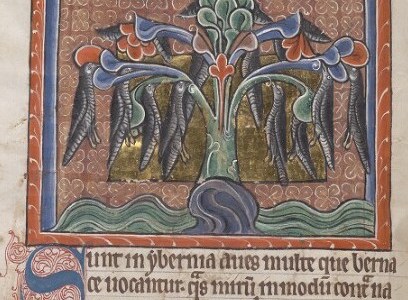
The belief in spontaneous generation led to some interesting ideas, including birds that grew on trees.
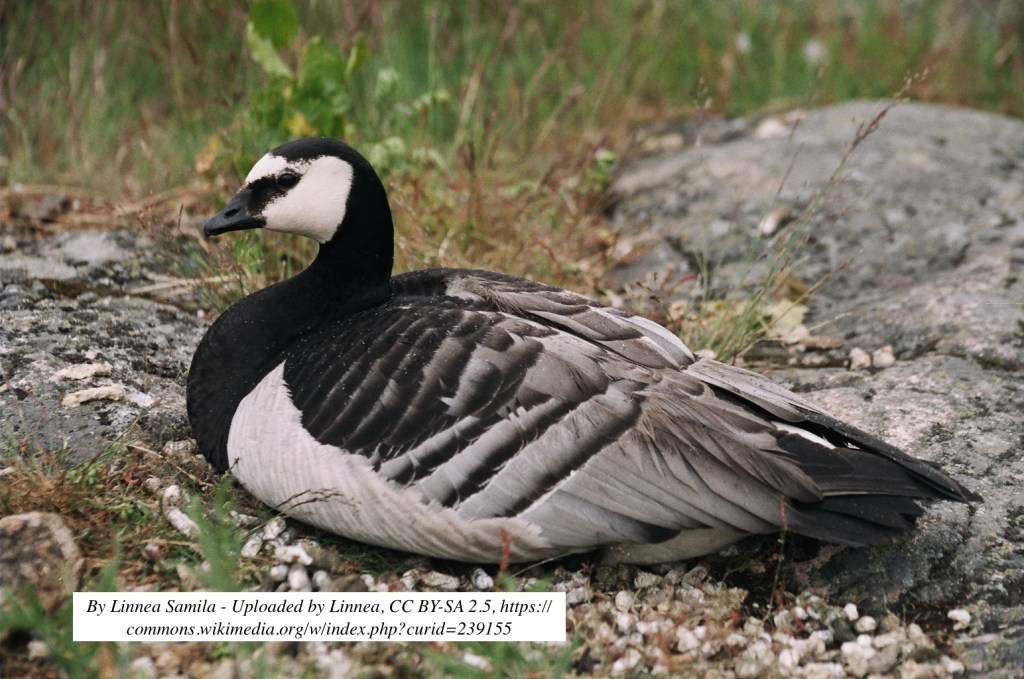
Barnacle Geese breed in the Arctic, thus their chicks weren’t seen in Europe. This led to an alternate explanation of their conception; namely the barnacle tree.
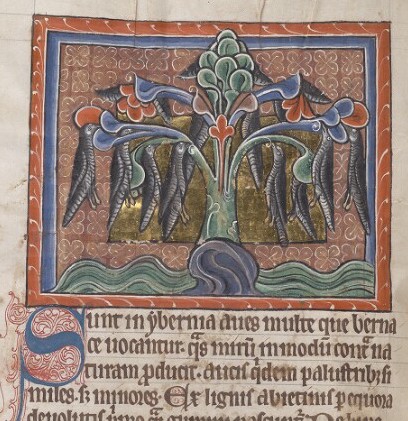
Bodleian Library, MS.
Bodley 764, Folio 58v
As the bishop Gerald of Wales (c 1146- c 1223) said: “There are here many birds that are called “Barnacles” [barnacoe] which … are born at first like pieces of gum on logs of timber washed by the waves. Then enclosed in shells of a free form they hang by their beaks as if from the moss clinging to the wood and so at length in process of time obtaining a sure covering of feathers, they either dive off into the waters or fly away into free air. . .”
Today we separate these creatures into two (unrelated) species which retain the myth in their names: the goose barnacle and the barnacle goose. I suppose if you squint it’s possible to see a resemblance of sorts. However, Gerald took it a step further. He said this wonderful process was irrefutable evidence of virgin birth and thus undeniable proof for the Virgin birth (not a particularly flattering analogy to my mind.)
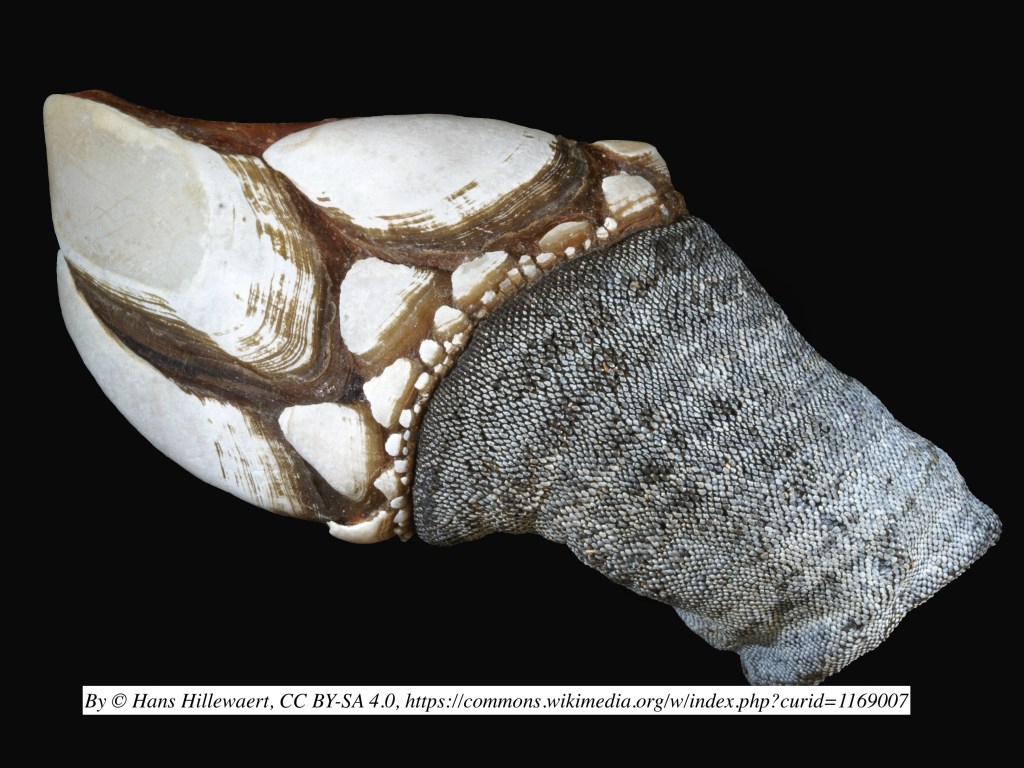
For Gerald, this particular spontaneous generation also meant (handily enough) that Christians could eat goose during Lent because geese were considered fish not fowl. “Wherefore in certain parts of Ireland bishops and religious men in times of fast are used to eat these birds as not flesh nor being born of the flesh. . .^
It wasn’t until the late 1800’s that the idea of spontaneous generation died a natural death, when Louis Pasteur (1822-1895) did an experiment proving that sterilizing broth prevented the growth of microorganisms. While his work didn’t totally kill the theory of spontaneous generation it was further evidence against it and the theory eventually faded (although I still think that rotten bananas are fruit fly seeds.)
Sources:
^Gerald of Wales, Topographia Hiberniae, v. 47, ed. Joseph Jacobs, The Jews of Angevin England: Documents and Records (London, 1893), p. 92-93. Scanned by Elka Klein. https://sourcebooks.fordham.edu/source/1188geraldwales-barnacle.asp [retrieved 1/21/20]
If you enjoyed this, perhaps you might also like:
What is it?
Three things you Must Have Before Getting a Puppy
A Pair of (unrelated) Poems
Puppies and Taxes
Is Math Broken? The Problem of Infinity
What you should know about money
Introducing the Glorious, Golden, Phi
Thanks for reading,
Kate
2/5/2020
Discover more from The Nature of Things
Subscribe to get the latest posts sent to your email.

 The Nature of Things