
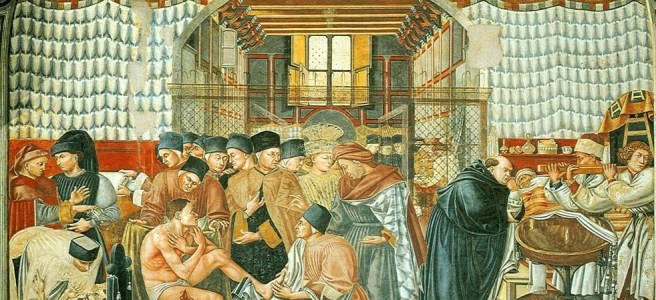
In ancient times, for the most part, people were cared for at home. Both men and women were healers and valued for their knowledge. Midwives, know as wise women, played an important role in child birth, but cared for the ill as well. Remedies included prayers, chants and incantations as well as charms and herbs. This “folk magic” was practiced from well before the Middle Ages, including by priests and monks.
In the Middle Ages Christianity began to crack down on heretics and the idea of “magic” began to shift in public perception. Christian prayers, ritual and sacraments were allowed, but other religions were either disparaged or made illegal. Remember, this is a time when miracles were thought to occur with some frequency. Gods and devils were seen to be at work in the world in a literal way. Traveling to a shrine to pray before the finger bone of a (Christian) saint was considered a legitimate way to fight what we now call disease.
Monasteries and nunneries often included an infirmary and accompanying herb garden and villagers began to turn to monks and nuns for aid. In Europe hospitals were originally charity houses, often attached to a monastery. Similar to earlier pagan shrines, they would take in those who were ill, but also the poor and destitute. The emphasis was on Christian charity rather than healing it and the common denominator was often poverty rather than health. Prayer was essential and beds were often placed with a view of a central shrine or alter, with an eye to saving the soul if not the body.
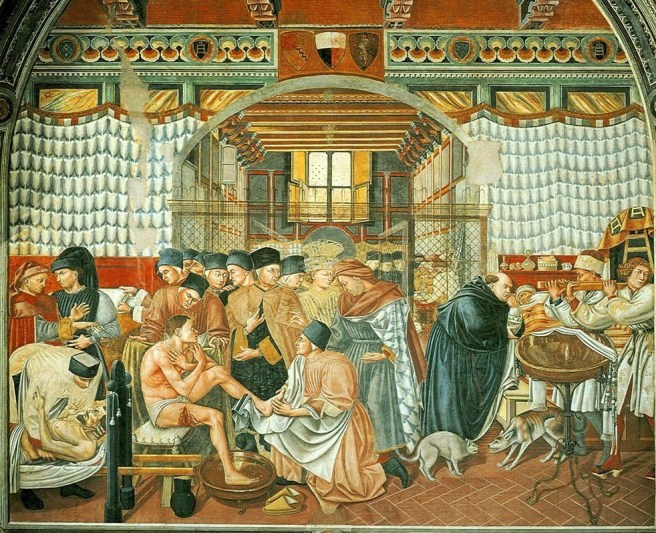
Hospitals eventually developed into more medically inclined institutions, but without knowledge of germ theory or contagion they were not conducive to health. They were often filthy and crowded, with a high mortality rate. During epidemics it was common to have multiple patients in a single bed laid out head to foot. Care consisted mainly of food and a place to sleep. Since the emphasis was on care the work often fell to women, hence the “invention” of nursing. While monks and lay brothers would work in the gardens the women would work directly with the patients – or inmates as they were sometimes called.
In the 12th Century the French Council of Bishops began instituting a policy of requiring an oath of chastity, poverty and obedience for nurses working in hospitals. While being chaste, obedient and poor the women worked long, hard hours. As well as feeding, bathing, praying and otherwise caring for the sick, nurses were also responsible for cleaning and, since many hospitals were also orphanages, for child care. Needless to say, it was not a great place to be a child. Or a nurse, or a patient, for that matter.
Given the options, however, it wasn’t the worst place to be (well, maybe for the patients.) Nurses often had responsibility for everything from choosing which patients to accept and when to send them home, to inventorying supplies. It was a thankless job. Laundry alone was was a brutal and never ending chore. Forget about the the spin cycle and imagine instead breaking ice on the river in the winter and hauling around bundles of wet laundry. The work was worse before the invention of bedpans, since nurses then had to escort patients to and from a common latrine. It was bad enough during the day, but at night ….
The absence of lamps … made the journey [to the latrine chamber] a precarious one; the weak, confused, and incontinent were prone to accidents, whose consequences the sisters were expected to remove.”^1
While women were struggling to keep their patients alive doctors were starting to receive official training. Unfortunately for women, as medicine became more respected and training more prominent women were left behind. Not only were they not allowed to attend school, but healers outside the Christian hospital setting started to change from being respected healers into witches.
Reference:
^1 Minkowski, W L. “Women healers of the middle ages: selected aspects of their history.” American journal of public health vol. 82,2 (1992): 288-95. doi:10.2105/ajph.82.2.288
If you enjoyed this article perhaps you would like these as well:
Vaccinations: History of a Controversy
Discover more from The Nature of Things
Subscribe to get the latest posts sent to your email.

 The Nature of Things
One thought on “Healing in the Middle Ages”