

“If I need to pick Char up at 2, I should leave here at 1:30.”
“I wonder if I have enough change for an ice cream cone?
“We’re getting how many puppies???”
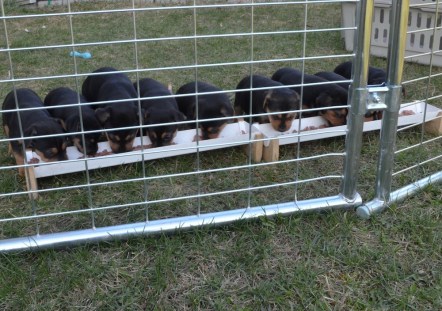
These and dozens of similar questions come up daily in our busy world and most of us calculate them without thinking about it. But imagine living in a world without numbers. Like everything, mathematics has a history and while humans began calculating early on, we haven’t always known how.
Say you let the pups out to play. How would you know if they all returned at dinner time? One early solution was to make a one to one correspondence. I can make one knot in a string for each puppy, or I could pile pebbles, or notch a stick. All of these and more were systems used to “count” before people knew what counting was.
In England, “tally sticks” evolved to become quite sophisticated. At first a stick was simply notched to indicate quantity, but by the 1400’s they were widely used as currency. Say I wanted to buy a pig from you but didn’t have any cash.
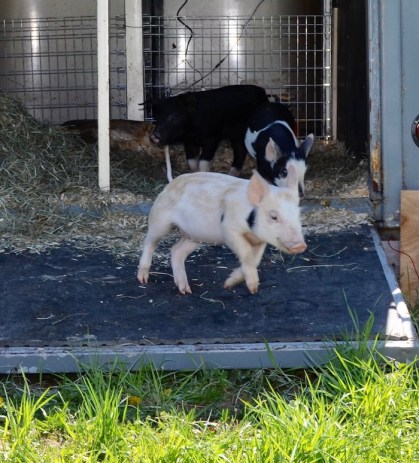
After deciding on a price, we would take a flat stick and cut notches in a certain way to indicate the price. We would then split the stick down the middle so that each side matched. In this way you and I would each have half a stick that recorded what we had agreed on.
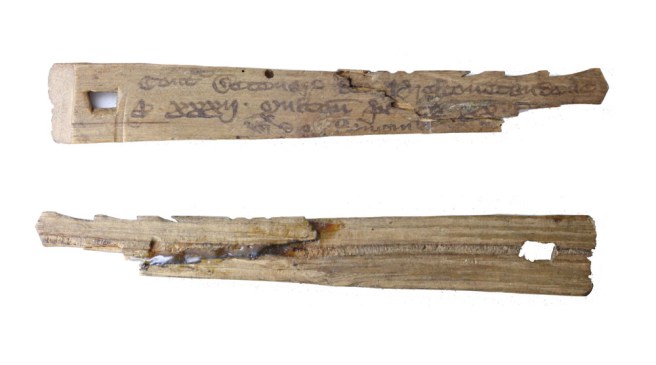
After a while it became the custom to cut the stick so that one half was longer than the other. The lender would keep the longer half which was called the stock. So, the lender was the stock holder, while the borrower got the short end of the stick (sound familiar?).
These and other details are known because of a book written in the late 12th century by a master exchequer for his apprentice. In it he described the process of cutting the tally:
“The manner of cutting is as follows. At the top of the tally a cut is made, the thickness of the palm of the hand, to represent a thousand pounds; then a hundred pounds by a cut the breadth of a thumb; twenty pounds, the breadth of the little finger; a single pound, the width of a swollen barleycorn; a shilling rather narrower; then a penny is marked by a single cut without removing any wood.”
If you feel so inclined, you can read the entire thing
(translated from Latin into English) here.
Tally sticks were used in England for paying taxes until 1826. Once they became obsolete the tally sticks collected dust in the House of Parliament until 1834 when Parliament ordered the sticks burned. Unfortunately, in their enthusiasm the workers got carried away and burned down the Parliament building.
I’m sure there is a moral there, but I have other things to think about (9 of them).

Discover more from The Nature of Things
Subscribe to get the latest posts sent to your email.

 The Nature of Things
5 thoughts on “Tally Sticks: Puppies and Taxes”