

Cute Cuddly Killers Are Our Responsibility
Much discussion has been going on for several years now about cats killing birds (and other animals). Some people call cat owners to task for letting their cats out to hunt. Others say cats are being needlessly demonized. I suggest the argument is more nuanced.
According to my research, habitat destruction is the main threat to wild birds. Natural predation is the leading cause of death for individuals within a species, but species as a whole are threatened by the loss of territory. However, having said that, the next leading cause of bird death in the US is cats.
Then come window strikes, windmills, car collisions, oil spills and pesticides, all of which kill large numbers of wildlife annually. Clearly cats are not to blame for endangering birds. Humans are.
What can we do about it? First, we need to stop destroying bird’s habitat. While we’re at it, we also need to reverse global warming, as global climate change will be disastrous for us all. (It may not be an exaggeration to say that electing Trump is the worst thing we could have done for birds since the invention of the internal combustion engine.) We can do our part by living lightly: driving less, using less, wasting less. However, that doesn’t answer the problem of cats killing birds.
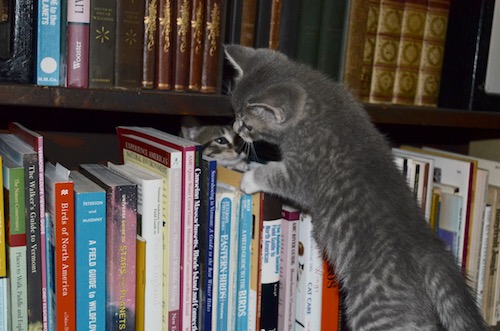
Our complicity with cats is complicated by the fact that cats are, technically, an invasive species. They are introduced to different areas by humans, meaning the native predators have not evolved to compete with cats, nor have the native prey adapted to avoid them. Furthermore, humans “subsidize” cats. We give them food and shelter, making it easier for them to survive than the animals who must compete with cats for the same territory. Feral cats are also often subsidized, as many people put food out for homeless cats in the well-meaning attempt to help them. So, not only are cats introduced predators, they also are given a strong advantage over native prey animals who hunt the same species. This throws off the natural balance.
All these introduced cats are killing huge numbers of animals, there is no doubt about it. I looked at a number of studies and read numerous articles relating to cat predation. The consensus is that cats kill billions of animals a year, mostly rodents and other small mammals, but also huge numbers of birds, amphibians and reptiles. The majority of the studies found feral cats were deadlier than house cats, but pets also account for large numbers of deaths. While there are some flaws in each of the studies I looked at the bottom line remains: cats are killers.
The problem lies in the numbers. According to the American Pet Products Association’s biannual survey, 85 ½ million US households have at least 1 cat, with the average number of 2. That’s approximately 170,000,000 house cats in the US.
I did a (decidedly unscientific) survey of my friends and found that 3 indoor cats and 4 outdoor cats killed 8 birds and 123 rodents over a years’ time.
One “cute little field mouse” was killed by an indoor cat, all other deaths were down to outdoor cats. Using my “study” we could say that 4/7 (57%) of cats go outside, giving 96,900,000 outdoor cats in the US. Of those, each kills, on average, two birds and 46 rodents a year (that number includes one rodent for every three indoor cats), leading to 193,800,000 bird deaths and over 4 billion rodent deaths yearly.
However, there are problems with my study. First, there were far too few cats in my survey to be able to extrapolate to other populations, much less the US as a whole. Second, most of the people I surveyed are rural and my guess (no proof) is that city people would be less likely to let their cats out, because of cars (although we have coyotes to worry about). Also, these numbers are based on the animals that people saw their cats bringing in, who knows how many went unnoticed. One person saw no bodies dragged in by the cat. Does that mean his cat is a vegetarian? Doubtful. Finally, even if these numbers could tell us something, they don’t take into account feral cats, barn cats, and other full time outdoor cats.
These were the sorts of problems I found in the various studies I researched. Some studies looked at thousands of cats, but several used fewer than 100 animals as the basis of their research. Many studies relied on surveys to find numbers of animals killed. Some were limited to a small area. Several didn’t distinguish between pets and feral cats, or between the type of animal killed. In each case, there was the trouble of determining how many animals a cat killed. Some researchers depended on what the owner saw, some collected scat, a few used radio collars to follow cats, one study used hidden cameras. None of these methods are particularly good, so I think it’s safe to say no one really knows how many birds or other animals are killed by cats.
However, no matter the method, every study (like mine) came up with alarmingly large numbers of animals falling prey to cats. Furthermore, the evidence from island populations is pretty damning. In a limited area such as an island, studies are more controlled and can look at specific populations. Many islands, including New Zealand, have clear evidence of cats decimating native populations of birds, reptiles and /or rodents, including endangered species.
So, while I don’t particularly trust any specific number, it is clear that cats are killing huge numbers of birds and other animals yearly. (I did find one study that said that cats are saving endangered species. But it turned out that was because cats were killing rats in an area where rats were the more dangerous predator for native wildlife.)
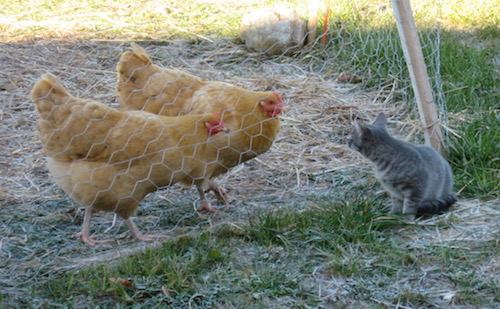
Interestingly, everyone I surveyed knew about the controversy about keeping cats indoors, but in about half the cases it didn’t seem to make a difference. None of the indoor cats asked to go out, while all of the outdoor cats did. I don’t know if that has any bearing on the issue (I know in my case I have a hard time keeping them in when they so clearly want to be outside.)
So friends, I’m sorry to say, that while the best thing we can do for birds, cats and people is to reverse global warming, we can start helping wildlife by keeping our cats inside.
I’m writing this with a kitten in my lap, another snuggled by my side and a third curled around my neck. All three are sleeping soundly. It’s hard to imagine them as cold blooded killers. And yet….
Discover more from The Nature of Things
Subscribe to get the latest posts sent to your email.

 The Nature of Things
8 thoughts on “Killer Cats”